Wednesday, November 30, 2011

Game Change?

In my last post I explained how there's two options, inflation or deflation.  Print more money, sell more bonds, or stop and reverse course causing deflation and a depression. According to my chart I drew almost 3 weeks ago now pointed to deflation/depression.

Well today we had quite the day in the markets.  Why?  Inflation.

http://www.zerohedge.com/news/here-comes-global-liquidity-bail-out

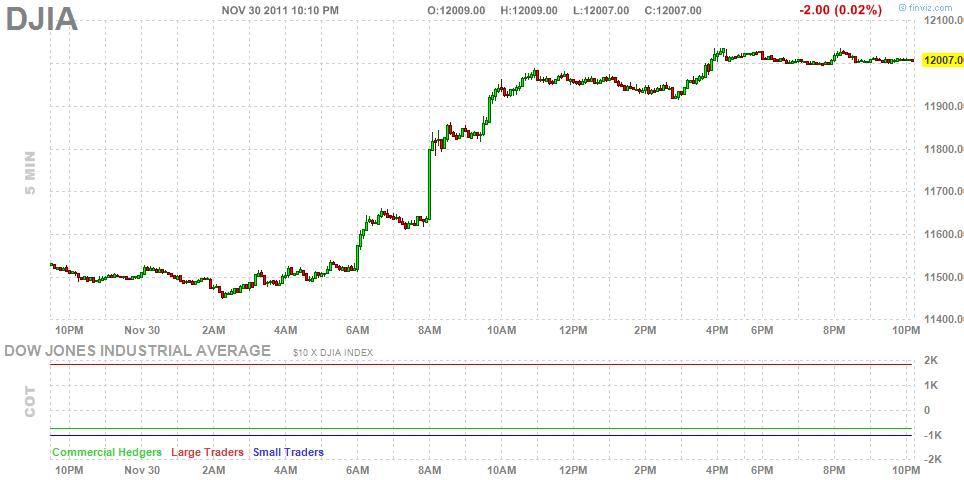
As you could see in the article, the Federal Reserve released this note at 8:00am EST along with Central Banks throughout the world coordinating a decrease of US liquidity swap rates.  On the chart below you can see at 8:00am EST the DOW went up $200 in 5 min.  This is one of the main ways inflation looks on a chart.  Instantaneous rises on news.


5 minute chart showing a $200 rise right at the 8am release of the Federal Reserve notice.

So the next question is, does that change the picture of my previous chart here?


For the time being, yes.  There was a nice rally today of almost $500 from the previous close that busted the similarities of this chart.  So where do we go from here...well let's check out some other posts.

http://www.zerohedge.com/news/did-fed-just-buy-europe-week

http://www.zerohedge.com/news/risk-rally-real

http://www.zerohedge.com/news/here-what-happened-after-last-global-coordinated-central-bank-intervention

So according to these three, nothing has fundamentally changed all that much.  There's other's that say this is great for the precious metals and show that risk is "on."  I am very tempered in my optimism.  I would tend to think this alone will only keep things up for a week, maybe a little longer depending on what news comes out, but maybe just the idea of breaking the very scary looking chart above will give enough people the idea that the economy is better.

If you couple that with a lot of fundamental upbeat news items today with the ADP payroll report being way higher than expected, the Chicago Purchasing Manager survey was much higher than expected and home sales as well, you begin to see how things could keep that chart from continuing it's decline.  I'm skeptical of these "fundamental" numbers until I see a couple weeks or months more of similar data, but it all added up for a great day.  But when the goal of the federal government, the mainstream media and the Federal Reserve is the Management of Perceptions to control economics, you can see why they would want everyone to believe that chart was busted and everything looks good.  Because in their world, the proper functioning of the economy is all about spending, even if they print money to give to you to spend.  As long as we're all spending, there's no problems, no matter the actual problems.  See they could care less that unemployment is 9% (by their numbers) as long as the government or everyone else makes up that spending decrease.  I'll get into all this some other time.


So one other thing I wanted to discuss is what's going on in the Middle East.  There's definitely growing "tensions" to put it mildly between Iran and pretty much everyone else in the area, including the US.  Turd Ferguson over at TF Metals Report has been all over this.

Here's a post with a lot of info.
http://www.tfmetalsreport.com/blog/3051/war-drums

Then today I see this...
http://www.zerohedge.com/news/china-will-not-hesitate-protect-iran-even-third-world-war

Needless to say, whatever is happening over there is nothing good.  Let's just hope our idiots in Washington don't do more stupid things to instigate Iran or anyone else to start a fight.  This would obviously be the biggest game changer imaginable.  It should definitely be watched closely.

Monday, November 28, 2011

Banks Making Money...still (through inflation)

I was planning on building to this post through history and slowly explaining things, etc.  But I just read an article and a post on TF Metals Report that make me want to skip ahead as this is very important for everyone to understand why things are the way they are, even if it doesn't make sense.

While everyone was upset about the $700 Billion in TARP money that the federal government gave multiple different banks in 2008 to "stay afloat" and "not collapse the system," one has to wonder, how in the world have the banks been making money for 3 years?  At least I would hope one would think that. 

Well, that's all a part of the system we have set up now.  See, $15 Trillion of debt that the U.S. government owes doesn't get just printed by the Treasury department and the US Mint in $10, $20, $50, $100 bills.  It's much more subtle than that.  So in order for the federal government to continue to fund deficits and more spending, they need to raise capital (money).  They do this by selling treasury bonds of differing length of time and differing yields (% returns) in return for money right here and now. 

Whenever the government sells these bonds to get the money to fund spending over the amount of tax revenues (deficit spending), two things need to happen...
1.) There needs to be buyers.  These buyers could be you, me, companies, banks, governments, whoever.
2.) The bonds need to be priced attractively enough that the return you get back is worth it vs. the amount of time and risk you take.

In essence, whoever buys government bonds, is investing in the government.

With government bonds, the risk of them defaulting (not paying you interest or your principal) is generally very low.  So low, I was taught in school that this is the "risk-free rate."  I don't believe that, but many still do.  The other aspect is the amount of interest you receive.  This is supposed to be determined by market factors where the buyers just won't buy the bonds if they don't get a high enough % return.  Right now, those %'s are very, very low.  Historically low.  Which is also the reason you can get a 30 year mortgage for 4.2%, a 15 year mortgage for 3.25% and interest on your bank account of 0.02% (or whatever ridiculously low amount you get).

In order for %'s of bonds to be so low, the price of those bonds should be really high.  Well, they are.  Higher than they've ever been.

In order for this to happen, there needs to be a substantial amount of buyers willing to purchase bonds at these high prices (low %'s).  Most people know that China is one of those main buyers.  I hear all the time that China owns us, and we owe China.  Well, it's true for the most part as they are the largest foreign bond purchaser of government bonds.  But they don't own us per se. 

"Overall, foreign holdings of Treasuries rose 1.9 percent in September to a record $4.66 trillion, U.S. government data show. Foreigners held 48.4 percent of the $9.62 trillion of outstanding public Treasury debt, the most since May. "

So 48.4% is foreign bondholders (people/banks/mutual funds/governments in foreign countries) and that leaves 51.6% as being domestically owned.  So we still "own" or owe ourselves (people/banks/mutual funds/government in the US).

But maybe you're thinking, what does that have to do with inflation?  Well, everything. 

See, when the government sells these bonds, they're sold amongst those buyers I listed. People, banks, mutual funds, government entities, etc, both foreign and domestic, but the amount that any one of those individual groups purchase changes constantly.  Since 2008, primary dealers (21 major banking and institutional investment houses that are approved vendors by the Federal Reserve) have been purchasing a large quantity of these.
http://newyorkfed.org/markets/pridealers_current.html
(MF Global was a primary dealer up until their bankruptcy 10/31/11.)

Why them?

Because they have access to the Federal Reserve's discount window (almost unlimited).  The Fed Funds rate is currently between 0-0.25 basis points (.0025% - Maximum).  So basically free money.  These primary dealers borrow money from the Federal Reserve for next to nothing, then purchase Treasury bonds which yield them much more in interest received.  Example, borrow money at 0% interest, purchase 30 year Treasury Bills that yields 2.93%.  Thus providing themselves an income spread that they book as profit each year, and pay bonuses, etc.

So how much money has these primary dealers borrowed with the Fed discount window?  According to the Bloomberg article below, $7.77 Trillion.  So while everyone gets all up tight about $700 Billion, you should get up tight about 11x that amount of nearly FREE money that the Federal Reserve loans both foreign and domestic banks.  This is how the banks have made money.  Not to mention they also use this money to make "investment" gains in the stock market and works hand in hand with the government to supply them extremely low interest rates to service the $15+ Trillion in debt. 

This money has been artificially driving down the government bond rates, which in turn have artificially driven down mortgage rates, interest rates on education loans, car loans, etc, and interest on checking and savings accounts.  It's a great time to borrow money.  Just like it was from 2002-2007.  So in 2008, we had a huge bubble that burst in the housing market due to low interest rates and loose lending practices, and put us in our current financial crises.  What's the solution to this?  Why creating even more borrowing with even lower rates and putting more money into the financial system (inflation).

One solution to this problem the last time we were in a similar situation was in the 1970's and Paul Volcker raised interest rates to 15-20%.  This caused a terrible recession, stagflation, shortages (because of government price caps), etc.  Well, the problem is, the US as a country was a net exporter in the 1970's (i.e. they had a trade surplus), so the pain really wasn't that bad back then because they had money still coming into the country from selling excess goods.  Now, the US is a net importer (we have massive trade deficits w/ Asia - money flowing out of the country).  Not only that, but we now owe $15+ Trillion.  If we increased interest rates to 15-20%, it may make the debt servicing (i.e. the amount of interest on $15+ Trillion) unservicable and lead to a default.  If we dont, we have massive inflation. 

So that's the choices.  Neither are good.  Which do you think the government will choose? 

Print more money by selling cheap bonds to the primary dealers and simulaneously inflating the $15+ Trillion away while paying 2-3% interest and providing Wall Street with access to free money and profits until there's hyper-inflation and a complete destruction of the dollar? 

Or increasing interest rates, bankrupting said primary dealers who need free money to stay in business, cutting spending by trillions to stop the inflation, causing deflation and a depression the likes nobody has seen ever, with no government support for the newly found poor and unemployed?

I know what they will do, but not that they should.

One thing should become quite clear to all at this point.  There is a very real and very tight connection between the Federal Government, Federal Reserve and Wall Street.  At this point, none can survive without the others.  At the head of this three headed monster is the Federal Reserve.

http://www.bloomberg.com/news/2011-11-28/secret-fed-loans-undisclosed-to-congress-gave-banks-13-billion-in-income.html

This is a good article and summary from about a year ago.
http://tfmetalsreport.blogspot.com/2010/11/tipping-point.html

This is a similar summary from today.
http://www.tfmetalsreport.com/blog/3036/great-ponzi
Friday, November 25, 2011

Banking and Government Debt

Banking on a consumer side of things is very simple to understand.  You deposit your money into your bank, they hold it for you, and give you interest for it.  You can withdraw cash at anytime and almost anywhere now through ATM's, write checks against your bank account, get traveler's checks for international use, use your debit card, and now even do online bill payment and banking (instead of paper statements).  All very convenient things that have evolved from technological innovations to make it simple and easy for the end user of money.  The 21st Century Act which legalized the acceptance of duplicate (copies) of checks, and even scanned checks greatly facilitated the rising use of technology involved with banking.  The reason you can scan a check on your phone, and through your mobile phone deposit that money into your bank is from this act.

As convenient as that is, it's even better as a money saver for the banks themselves as they no longer have to employ people to do all of that work of taking a check, sending it to the Federal Reserve (clearing house), which then sends it to the original bank of the check writer.  It's all done electronically, in the same day.

   Side Note....
      The rise in consumers doing the work that would have otherwise been done by the business itself by paying employees, is rapidly racing into our economy.  No longer is there people to pump your gas (except in NJ), check out your groceries at the store (with the auto checkouts), etc.  This is due to inflation and also the minimum wage laws, and also a reason that the unemployment of people ages 16-24 is around 45-50%.  Here's a great article that discusses this unpaid labor (Shadow Labor/Work) that we all do and references another article from the NY Times below that. 

Banking on the inside isn't as easy to understand.  In fact, through years of college, I never fully understood it as my college classes focused on the different laws, interest rates, clearing system, markets and products of those markets.  Basically, to teach me what the different banking products/services are, and how to sell them, not really understand them and where they came from.

This book changed all of that.  It stripped away all of the details on the modern system to start, and went straight to uncovering the "Mystery of Banking" from the beginning.  As it really was a mystery to me even after being "educated" on it in college.  Read all, some, whatever you feel like to get a basic understanding of how banking evolved.  The topic is much larger than I could explain in a post but I'll summarize below.    http://mises.org/Books/mysteryofbanking.pdf

Banking itself is linked more to money changers of ancient history.  Greeks and Romans had the first kind of banks where they changed currency from one to another, they were involved heavily in business transactions and lending.  The Knights Templars used a system of storage in their vaults and transfer through writing deposits on paper and allowing the depositor to withdraw similar items and wealth at any Templar location.  This was useful as theft while traveling was common.  Then we get to the more common banks in Italy with the Peruzzi and Bardi families with their double entry accounting system and gold florins (The World Reserve Currency of the day).  This is where I can find the first big lending to governments for the Hundred Years War where the two family lent England 1.5M florins. There were many other loans to governments, but this was notable because the default caused the wealthy families to go bankrupt.  Other banking started up.  Here is a brief history.  http://www.historyworld.net/wrldhis/PlainTextHistories.asp?groupid=2450&HistoryID=ac19&gtrack=pthc

Briefly, I explained fractional-reserve banking at the end of this post.  In the 17th and 18th centuries, goldsmiths began to pop up as banking became the new business to get into. The beginning is summarized in the first paragraph well here and goes on to describe the first goldsmiths conversion into banking and their lending to the government of England.   Merchants also got into banking from their international trading and storage of wealth in these goldsmith vaults. http://heritagearchives.rbs.com/wiki/Edward_Backwell,_London,_1653-82

These goldsmiths/bankers transitioned into some of the first national banks like the Bank of Scotland and the Bank of England.  These banks are private institutions.  The Bank of Scotland was very different than the Bank of England at the beginning though.  The Bank of Scotland primarily lent money to businesses in Scotland.  The Bank of England however was set up to be the primary lenders to the government to finance England's war with France.  As the wealthy new bankers found out, it was much more lucrative to lend to governments that always had a flow of taxes to pay interest on loans than businesses.  You just had to make sure they would always pay the interest as if the government defaulted, they would immediately go bankrupt.  Many of them did.

Side Note...
It was war that depleted England's reserves.  It was Charles I (in 1640) that first confiscated the private gold at the Royal Mint for a forced loan to the government to pay for his wars.  This action put into question the Royal Mint as the safest place to store money.  It was the goldsmiths that benefited from this as people preferred to deposit their money with them.  It was the goldsmiths that had financed Oliver Cromwell in the English Civil War to overthrow, try and execute Charles I.  It's the financing of wars that first created the Bank of England.

These loans, just like the goldsmith loans were backed by either gold or silver that was on deposit at the bank.  Only this time, it wasn't the gold or silver that the government owed, but from the goldsmiths and the merchants who stored their money there, who funded the Bank of England.  The Bank of England is important because it became the model for all Central Banks that were created after.

The United States has a long history of battles with banks.  It is the U.S. Constitution, Article 1, Section 10 that states only gold and silver coin is legal tender of payments, and no state shall coin money.  This allowed for the creation of a government bank to unify all of the currencies used throughout the colonies at the time, as well as set the legal payments of the country and it's citizens linked to a gold or silver coin.

"No State shall enter into any Treaty, Alliance, or Confederation; grant Letters of Marque and Reprisal; coin Money; emit Bills of Credit; make any Thing but gold and silver Coin a Tender in Payment of Debts; pass any Bill of Attainder, ex post facto Law, or Law impairing the Obligation of Contracts, or grant any Title of Nobility."

As Madison states in The Federalist Papers, No. 44...

"Had every State a right to regulate the value of its coin, there might be as many different currencies as States; and thus intercourse among them would be impeded; retrospective alterations in its value might be made, and thus the citizens of others States be injured; and animosities be kindled among the States themselves.  The subjects of foreign powers might suffer from the same cause, and hence the Union be discredited and embroiled by the indiscretion of a single member."

I bring this up because this is exactly what is happening in the European Union right now after ignoring the fiat currency issues.  The idea was to use the Euro as one currency to build a stronger European Union.  The rules of the Euro are supposed to be that each country uses fiscal prudence in their own country to support the greater Euro currency and European Union.  But the problem is that Portugal, Ireland, Italy, Greece and Spain (PIIGS as it's referred to) basically borrowed money from the more productive countries of France and Germany to fund their own social debt spending which is causing great concern and "animosities" between the countries.  Eventually, something will have to be done to rectify the situation.  Either the debtor countries will have to leave, or the stronger German and France countries will have to continue to loan money.  Either way, it doesn't end well in my opinion which I will get into later.

The same is what is happening in the United States right now, it's just we don't discuss it as the US dollar is the World Reserve Currency and no State has caused any other to visibly suffer, or discredit the dollar.  But I guarantee that it will happen here as it is in Europe now.  California and Illinois will be at the forefront.  California by all practical purposes has defaulted and needs constant new bonds to fund the state.  Illinois is also in a similar boat.  Only California is the equivalent in GDP size as Italy, and Illinois the size of Turkey, so eventually, the light will be shining on the U.S and it's problems.
http://www.economist.com/blogs/dailychart/2011/01/us_equivalents
http://en.wikipedia.org/wiki/List_of_countries_by_GDP_(nominal)

Next I will discuss the history of money in the U.S., it's national banks, and the development of the Federal Reserve.  As well as the changes that have occurred in our own currency.